

A Smart Thinking Move You Might Not Be Using
Coarse Graining - Scale Switching

Much advice about “thinking better” is vague.
Focus. Prioritise. Be rational.
But good thinking isn’t a personality trait. It’s a sequence of operators — reusable moves in the flow of cognition.
In Trident-G terms, thinking follows a loop:
Frame (Y + resolution) → Commit (probe + stop rule) → Infer (Gf) → Commit (action) → Test → Bank
Frame (Y + resolution): Decide what “success” means and how zoomed-in you need to be.
Commit (probe + stop rule): Choose what evidence you’ll look for and when you’ll stop thinking and move.
Infer (Gf): Do the heavy lifting: model the situation, generate options, update beliefs.
Commit (action): Pick the next move. Make it concrete.
Test: Check it against reality. Look for mismatch, not comfort.
Bank: Compress what worked into a reusable mindware script so it transfers next time.
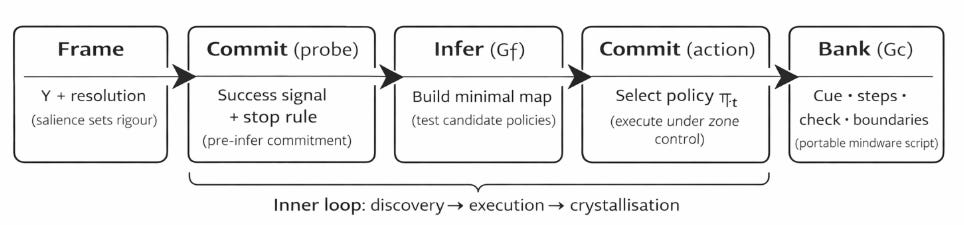
Every intelligent act moves through that cycle. And one of the most powerful operators inside it is something most people do accidentally — and sometimes badly.
It’s called:
Deliberate Coarse-Graining
And this essay is using it right now.
The Fine-Grained Script (What the Mindware Actually Does)
Deliberate Coarse-Graining is a resolution-control operator. It runs when your cognitive load rises or when your planning horizon expands.
Here is the actual script:
Cue
Either:
Details are crowding strategy.
Or: You are planning across longer time horizons.
Example: Writing a Thesis
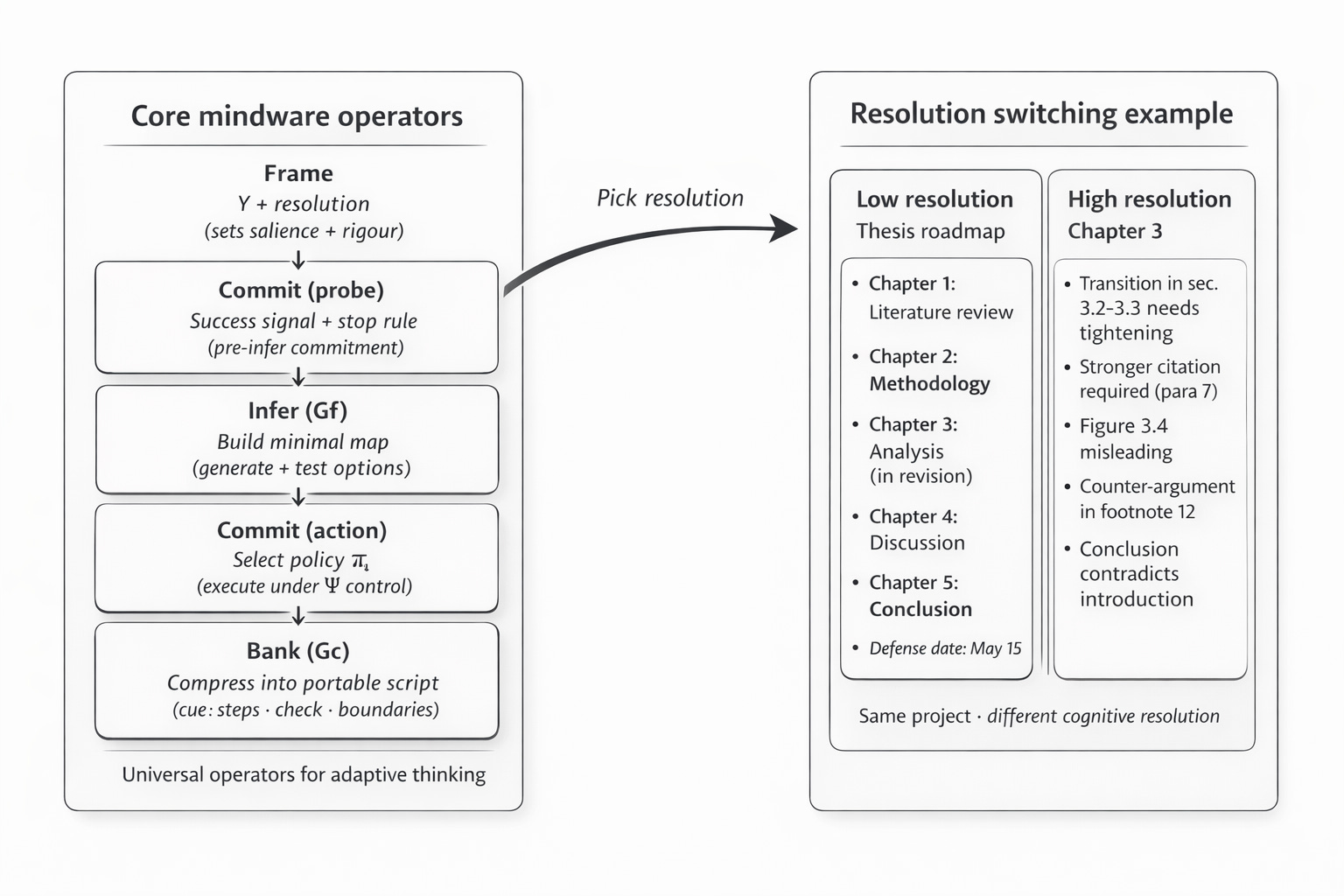
At high resolution, Chapter 3 contains:
A weak transition between sections 3.2 and 3.3
A missing citation in paragraph 7
A misleading Figure 3.4
A counter-argument in footnote 12
A contradiction with the introduction
At strategic resolution, the map becomes:
Chapter 1: done
Chapter 2: done
Chapter 3: analysis (revision stage)
Chapter 4: outlined
Submission: May 15
If you try to carry footnote 12 into the roadmap, you overload the system.
So you run Deliberate Coarse-Graining:
Chapter 3 (Capsule)
Purpose: answer RQs using dataset Y
Done: all RQs supported + figures clear
Depends on: ethics + cleaned data
Next: fix 3.3 transition + citation gap
Stop: reopen for supervisor feedback
Now the roadmap remains true without being swamped by detail.
“Chapter 3” as a node that still preserves reality
Low-level truth (execution mode):
You’re adjusting transitions, repairing claims with citations, fixing figures, tightening a counter-argument, resolving contradictions.
High-level question (strategy mode):
“Will I hit the submission deadline, and what’s the bottleneck?”
So you capsule the chapter:
When to zoom out vs zoom in
Notice what we just did.
We described a detailed script for Deliberate Coarse-Graining.
Now we can compress that into a single higher-order operator inside the G-Loop:
Map → Pick Resolution → Commit → Test → Bank
At this level, Deliberate Coarse-Graining is simply:
The Map Refactoring Operator.
It sits inside the Map phase of the G-Loop.
It determines the grain of the representation before inference runs.
So at the highest level, the story becomes:
Good thinking selects a target (Y).
It regulates load to stay within corridor.
It switches resolution appropriately.
It commits.
It tests.
It banks portable structure as transferable mindware - as crystallised intelligence..
The entire piece you’re reading can now be compressed into:
“Good thinking = selecting the right representational grain before acting.”
And that compression is itself an instance of the operator!
That’s recursion! It’s a self-demonstration, not just an explanation.
Why This Is a Type-2 Move
In Trident-G terms, this isn’t just tuning. It’s an installation.
Type-1 transfer:
Improved performance through tuning existing mechanisms under similar conditions (same map, better stability).Type-2 transfer:
Structural change that installs a portable operator which survives context shifts (new map, reusable script).
When you first learn Deliberate Coarse-Graining, it feels effortful. You over-abstract or under-abstract. You collapse too much or too little.
But once installed, it becomes a portable operator:
You use it in writing.
In product strategy.
In relationships.
In research design.
In long-term life planning.
It survives ‘wrapper’ swaps - changes in context and surface detail.
That’s the definition of portable mindware - that is, crystallised intelligence (Gc).
The Failure Mode (Thin Compression)
The failure mode usually shows up when we feel relief the moment we “zoom out”. The map gets shorter, anxiety drops, and it feels like progress, so the brain stops there. But what actually happened is not resolution control, it’s information deletion.
In other words: you didn’t compress the representation, you discarded the constraints that make it runnable. The result is a thin label that cannot drive action, cannot be tested, and cannot be re-entered without starting from scratch.
There is a counterfeit version:
You compress detail but lose invariants.
Examples:
“Chapter 3: basically fine.” (No success signal.)
“Health: improve.” (No causal structure.)
“App: almost done.” (No dependency clarity.)
That’s not coarse-graining.
That’s vagueness.
Real coarse-graining preserves:
Direction of value
Dependencies
Testability
Re-entry path
If those disappear, you’ve lost the structure. No banked crystallised intelligence.
If there is any smart thinking operator you want to explore like this, please add in comments!