

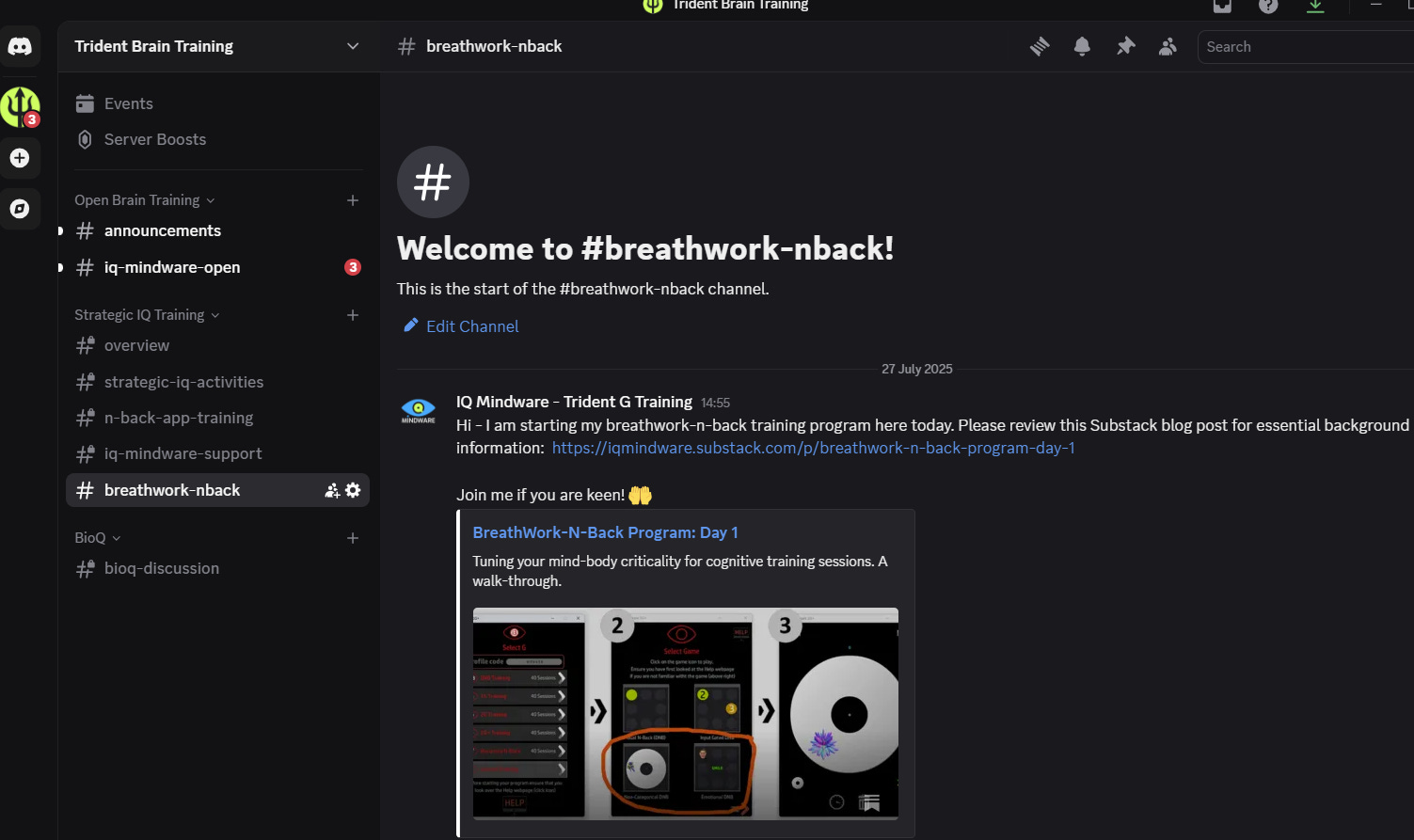
BreathWork-N-Back Program: Day 1
Tuning your mind-body criticality for cognitive training sessions. A walk-through.

Note: This program will be continued on the Trident Brain Training Discord Channel - Not Substack
My 24 Day Program
My current cognitive training program - a 24 day commitment (around 6 days a week for 4 weeks) - involves this flow:
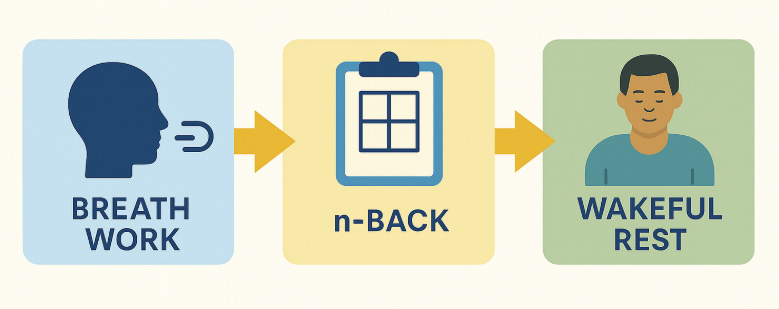
The breathwork and n-back training takes about 25 minutes in total. In this message I am focusing on this combination. If you are interested in the ‘quiet time’ post-training effect, check out this Substack article I wrote.
(I personally combine this with other regular practices for overall health and wellbeing that are now a part of my life, including high intensity boxing (circuits, bags, mits and sparring) 2-3 times a week), paragliding and trail running (500-1000 miles a year) and cold water immersion/swimming! I use Strava - great app for physical training!)
1. Breath Work Pre-Training
Integrating a targeted breathing routine before your n-back sessions primes your whole mind–body system to operate at its ‘critical edge,’ where both heart and brain are most adaptable, responsive and ready to learn.
Tuning Your Heart’s Fractal ‘Sweet Spot’
Your beat-to-beat variability isn’t random noise — it reflects how flexibly your autonomic nervous system can respond. Detrended Fluctuation Analysis (DFA-α1) around ~1.0 indicates that your heart is balanced between rigid metronome-like pacing and chaotic randomness. By deliberately perturbing your system with paced breathing (see below), you temporarily dip DFA-α1 below 1.0 (via hyperventilation), then elevate vagal tone (via breath-hold), and finally restore fractal variability (via slow diaphragmatic breathing). The net result is a rebound of your DFA-α1 back toward that optimal ~1.0 zone — your body’s “edge of chaos” where resilience and responsiveness peak.
Synching Heart and Brain Criticality
Neuroscience shows that when your heart’s fractal complexity is healthy and optimally tuned, your brain’s long-range temporal correlations (LRTCs) in rhythms like alpha also peak — signaling the same near-critical state in cortical networks. In practice, that means your neural circuits for working memory, attention, and relational binding (the very networks you engage with my n-back app) are primed to flexibly recruit just the right level of synchronisation.
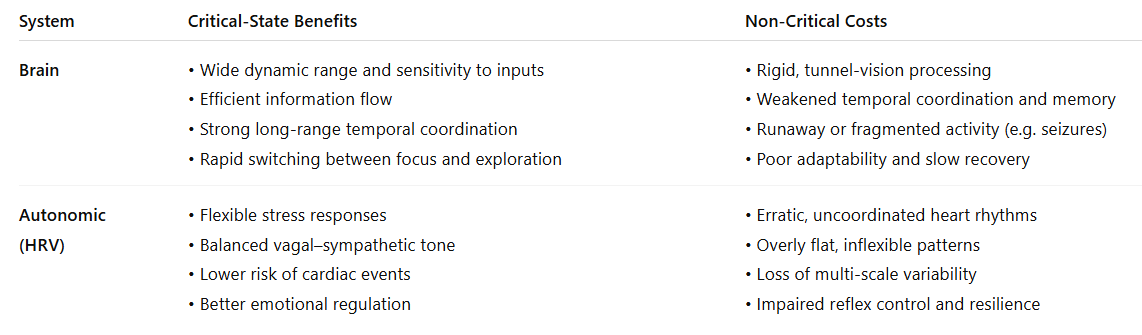
Here is a table summarising the benefits of being in states of brain-body criticality - and the non-critical costs. Click to enlarge.
A Three-Phase “Shock and Reset” Breathing Protocol
This is the procoal I am using for each session:
Bellows Breathing (20–30 bpm, 30 breaths): This is essentially a brief bout of hyperventilation. This drops your blood CO₂ and creates a a mild respiratory alkalosis. It floods your system with sympathetic drive — temporarily reducing HRV complexity and sending a strong “challenge” signal.
Breath-Hold (30–90 s) on the Outbreath: Here is where CO₂ rapidly builds back up. The apnea triggers the diving reflex, slamming on the parasympathetic “brake,” boosting CO₂ tolerance, and flushing in multi-scale oscillatory patterns.
Resonance Breathing (6 bpm for 3–5 min): This is slow ‘belly breathing; (first expanding your belly and then chest in slow inhale, and then reversing this, with about 1 breath cycle every 10 seconds (1 Hz). You can somewhat extend the outbreath if you want. This type of deeply relaxing breathing maximises respiratory-sinus arrhythmia (RSA), guiding heart and brain rhythms back to a highly coherent, flexible state.
Guided Breathwork Resource
I have started with this 11 minute practice video.
Here is Sandy’s YouTube Channel: https://www.youtube.com/@BreatheWithSandy
Notes on this guided practice
I practiced the session sitting cross-legged or half-lotus.
It is important to use your diaphragm muscles with intention and emphasis in doing this practice. You are training and strengthening your diaphragm muscles for breathwork, as well as learning particular techniques.
You will likely experience mild signs of hyperventilation - e.g. tingling in the arms or light-headedness after the fast ‘in-out’ breathing rounds. That’s OK - provided it is within a ‘safe space’ of practice for you.
You can cultivate open monitoring mindfulness during these practices by heightening your awareness of your sensations and perceptions during the breath hold phases of the practice. Remember, ensure you are deeply relaxed during these phases too.
I use the ‘return to normal breathing’ period in this guided breathing video to do the resonance breathing - phase 3 of the breathing. I extend this 2-3 minutes beyond the end of the video too.
Why This Breath-Work Matters for n-Back Training
Enhanced Neural Plasticity: By cycling your autonomic system through challenge and recovery, you amplify synaptic plasticity windows (via vagal and baroreflex interactions) just before engaging working-memory circuits.
Sharpened Focus & Alertness: The abrupt switch between sympathetic and parasympathetic modes heightens cortical excitability and attentional gating, so you start each block of n-back with clearer, more responsive neural ensembles.
Sustained Resilience: Regularly nudging your DFA-α1 and LRTCs back toward criticality builds longer-term autonomic resilience — so over weeks, your ability to stay focused under cognitive load improves, and recovery between intense blocks speeds up.
So in short, this breathing ‘tune-up’ sort of jolts your physiology out of autopilot, and helps reset it to a peak-performance state. By layering n-back training on top of that near-critical heart–brain synchrony, you give yourself the best possible launchpad for both rapid gains in working memory and deeper, more resilient cognitive improvements.
2. Capacity & Cognitive-Skill Training
(15 minutes of dual n-back)
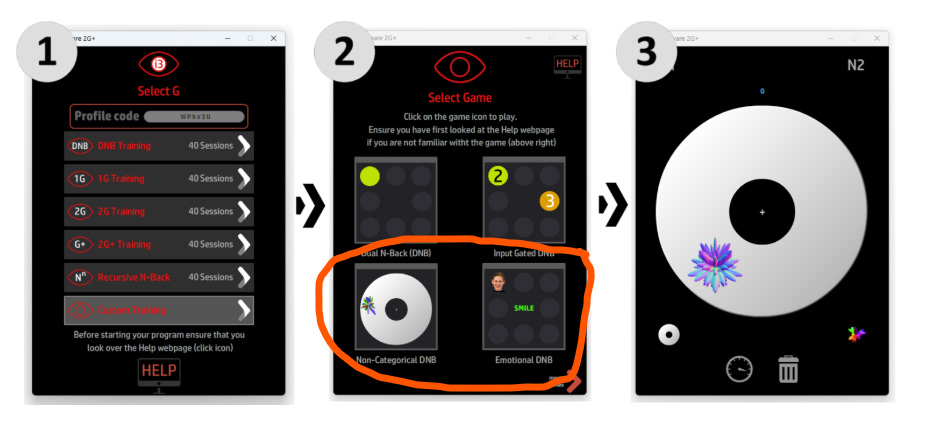
Episodic Dual n-Back
What you do: Track ever-changing, complex 3D shapes in new positions each round.
Why it helps:
Grows your mental RAM, so you can juggle more pieces of information at once.
Strengthens hippocampal pattern separation and builds richer internal maps, fueling fluid-intelligence breakthroughs.
Emotional Dual n-Back
What you do: Ignore moving emotional faces and focus on word-color pairings under conflict.
Why it helps:
Trains you to filter out stress-inducing distractions, boosting cognitive resilience.
Widens your stress-tolerance band, so you stay composed under pressure.
Why These Go Beyond Classic Dual n-Back
Targeted neural circuits: Classic n-back mainly taps fronto-parietal working-memory networks. Our episodic version adds deep hippocampal engagement for map-building, while the emotional version recruits prefrontal–limbic pathways for stress regulation.
Far-transfer synergy: By training both g-axis capacity (via richer memory maps) and r-axis resilience (via emotional filtering), we expand the full area of your adaptive ‘critical band’ — so you gain thinking power and the calm to use it.
Real-life readiness: You’ll not only hold more in mind, but you’ll also stay focused when stakes are high — exactly the combination that predicts success on fluid-reasoning tests, creative problem solving, and everyday challenges.
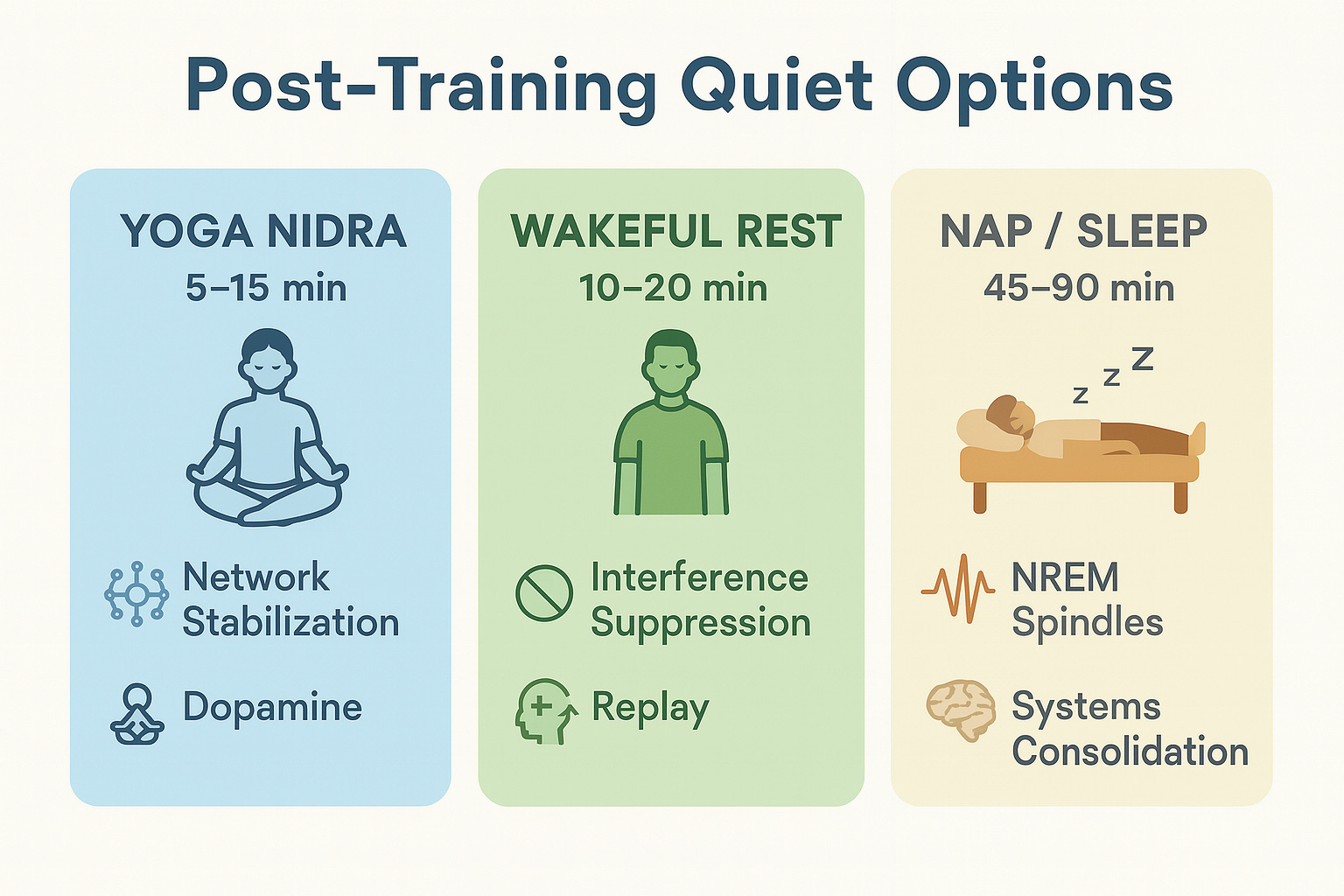
Post Training Quiet Time
Ensure you integrate this into your training workflow. Your options including wakeful rest are explained here.
Join me on Discord if you want to integrate this into your current training program.
Have fun!
Mark