

Human-Artificial General Intelligence (H-AGI) Protocol Summary
Extending cognition with AI while protecting the human skills that make intelligence adaptive

The Trident G-based approach to AI is based on the following two principles.
1. Extend functional reach with AI tools.2. Protect and train the human meta-control layer.
This fits the cognitive-offloading (‘extended cognition’) literature: external tools can genuinely extend cognition by moving memory, search, transformation or calculation demands into the world, but the benefit depends on whether the person retains appropriate metacognitive monitoring and control. Risko and Gilbert frame cognitive offloading as a normal feature of distributed cognition, but one whose use depends heavily on metacognitive judgements about internal demand and tool reliability. (1) Generative AI intensifies this because users must prompt, interpret, assess and rely on outputs, creating new metacognitive demands. Tankelevitch et al. make exactly this point: GenAI requires a high degree of monitoring and control around prompting, output assessment and workflow use. (2)
The two-pronged model
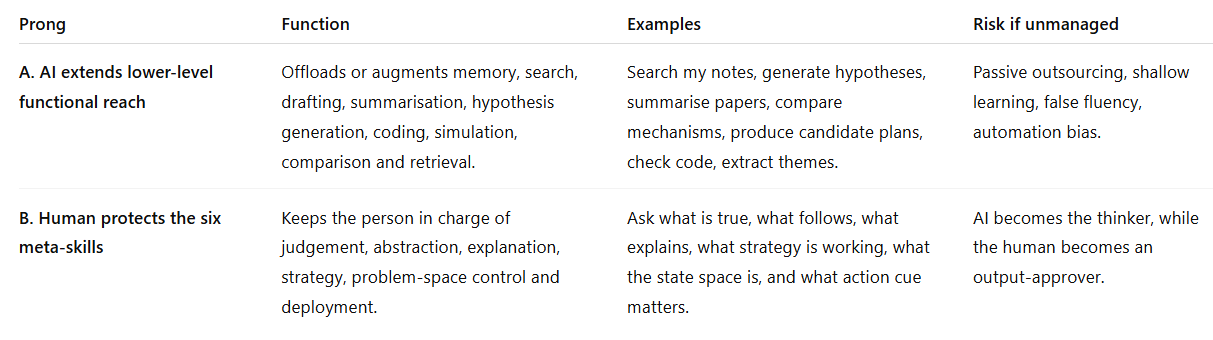
This is consistent with UNESCO’s human-centred framing for GenAI in education and research, which emphasises human capacity, agency and responsible design rather than mere adoption of tools. (3) It is also consistent with the OECD’s current position that GenAI can support learning when embedded in clear teaching principles, but that simple outsourcing can improve visible performance without producing real learning gains. (4)
The six protected meta-skills
The six skills become the human control layer. There is good empirical support for the trainability of these cognitive skills to augment general intelligence, and we are building them into our latest interation of the IQMindware cognitive training apps:
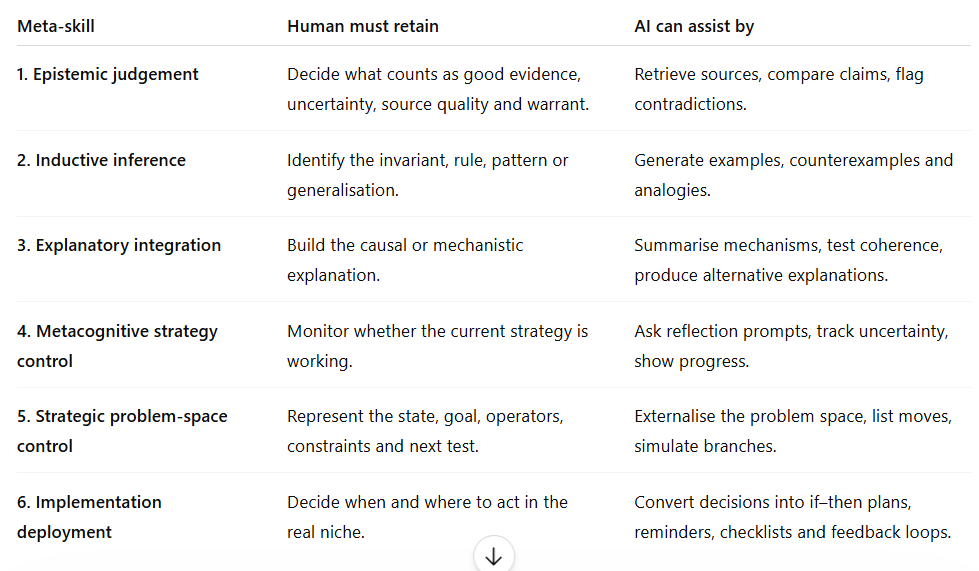
So AI becomes an ExQ (‘extended intelligence quotient’ amplifier: it extends what the person can search, compare, remember, simulate and produce. But the six meta-skills remain the fluid intelligence control layer.
The core design principle
The system should never simply ask:
What can AI do for me?
It should ask:
Which cognitive operation should AI extend,and which human meta-skill must remain active?
For example:
AI searches memory→ human judges relevance.AI generates hypotheses→ human selects boundary tests.AI drafts explanations→ human checks causal coherence.AI simulates options→ human defines the problem space.AI creates an implementation plan→ human chooses the cue, action and feedback loop.
That also protects against automation bias: the tendency to over-rely on automated outputs simply because they are available or fluent. Human oversight is not enough unless the human retains real authority, understanding and the ability to challenge the system. (5)
IQ Mindware’s Trident G framing
In Trident-G terms:
AI tooling extends ExQ:
memory search, retrieval, comparison, generation, simulation, scaffolding.
The six meta-skills protect G:
judgement, abstraction, explanation, monitoring, problem-space control and deployment.
Zone / working memory / cognitive control capacity training protects the lower substrate:
attention control, cognitive bandwidth, relational workspace and lure resistance.
Puzzles and prompts bridge the levels:
presemantic control → explicit problem-space reasoning → real-world action.
This highlights the direction our work is now going.
The H-AGI framework with deeper content and tutorials is explored specifically in the paid content - with any minimal contribution for this research.
Keep reading with a 7-day free trial
Subscribe to IQ Mindware Substack to keep reading this post and get 7 days of free access to the full post archives.