The Cereal Wasn’t the Strategy
Strategy in the Wild #1: SPACE–PACE Toolkit for Creative Strategic Resilience

This strategic intelligence post is especially relevant in today’s economy. The World Economic Forum expects 39% of core workplace skills to change by 2030, even as labour-market transformation produces a projected net gain of 78 million jobs. Uncertainty is high—but so is the strategic potential for people and organisations that manage their attention, protect their base, keep learning and make well-judged moves into emerging opportunities.
In 2008, the founders of Airbnb faced a problem that will be familiar to anyone who has tried to build something uncertain.
They had an idea they believed in. Almost nobody else did - or cared.The company - then still known as AirBed & Breakfast - was struggling to attract customers or investors. Brian Chesky and Joe Gebbia were racking up credit-card debt. The wider economy was deteriorating at the same time. Their business needed more time, but time itself was becoming unaffordable.
So they started selling breakfast cereal!
During the 2008 US presidential election, the founders designed two limited-edition boxes: Obama O’s, marketed as “the breakfast of change”, and Cap’n McCain’s, presented as “a maverick in every bite”.
They bought cereal, created the packaging and sold the boxes for $40 each. The stunt generated around $30,000! — enough to give their endangered company some additional runway. It also provided the founders with an unusual physical exhibit when they later interviewed for Y Combinator, the influential start-up accelerator.
It is a great story. It is also easy to draw the wrong lesson from it!
The standard interpretation is that the founders were extraordinarily creative and persistent. When conventional funding failed, they “hustled”. They thought outside the box — actually into a box ☺️ — and refused to let their company die.
All of that is true, yes.
But creative hustle is too vague to be a useful strategic principle. Many desperate side projects consume scarce time, scatter attention and pull their creators away from the very thing they were trying to save.
The deeper question is not:
How can I imitate Airbnb’s creativity?
It is:
How can I use an unexpected opportunity to protect my main mission without allowing that opportunity to replace it?
That is where the story becomes a useful example of SPACE–PACE strategic cognition.
Strategy is more than pursuing a goal
Most discussions of strategy focus on one objective.
Launch the product.
Win the match.
Secure the investment.
Complete the project.
But no important goal exists in isolation. Every mission draws upon a wider system of limited resources:
Time ⏳
Money 💷
Attention 🎯
Energy ⚡
Skills 🛠️
Relationships 🤝
Reputation ⭐
Tolerance for risk 🎲
Future options 🛤️
A local success can damage that wider system.
You can win the contract while exhausting the team. You can develop the perfect product while running out of cash. You can seize an exciting opportunity while abandoning the work that gave your larger project its direction.
For those familiar with my Trident-G theory, this is what it looks like when a system is pulled out of the near-critical ‘zone’.
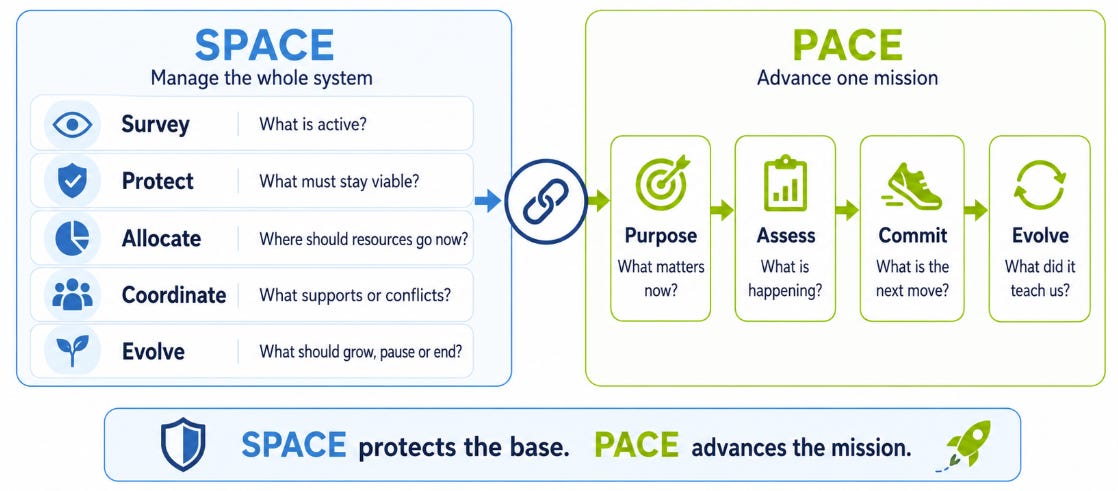
The SPACE–PACE framework separates these two levels of strategy.
SPACE: keep the whole system viable
SPACE is the portfolio-level view. It asks how your different commitments fit together and what must remain protected while you pursue growth.
The letters stand for:
Survey 👁️
What domains, projects and obligations are currently active?Protect 🛡️
What must remain viable—financially, physically, relationally or reputationally?Allocate ⚖️
Where should limited resources go now?Coordinate 🔗
Which activities reinforce one another, and which are competing destructively?Evolve 🌱
What should grow, continue, combine, pause, recover or end?
SPACE is therefore not another productivity system for doing more.
It is a way of seeing the whole field before one urgent or exciting demand captures all available resources.
Its central question is:
What must remain viable while I pursue this opportunity?
That question matters because a strategy that succeeds in one area while degrading the foundations of the whole is not a genuinely adaptive strategy.
[Viability here can be thought in terms of allostasis for a biological analogy.]
PACE: advance the mission
Within that wider portfolio, PACE organises action around one mission:
Purpose 🎯
What result actually matters?Assess 🔍
What is happening, which evidence matters, and what is likely to follow?Commit 🚀
What is the best-supported next move, and is it time to act?Evolve 🔄
What happened, what did it teach us, and what should change next?
PACE is a spiral rather than a one-way checklist. Action produces feedback. Feedback may strengthen the current approach, call for a local adjustment or require the whole model to reopen.
Together, the systems address two different questions:
SPACE: Are we protecting and improving the wider system?
PACE: Are we advancing this particular mission intelligently?
Airbnb’s cereal boxes make sense only when we keep both questions in view.
SPACE: protect the base
The visible challenge facing the Airbnb founders was weak customer adoption.
The more immediate strategic threat was simpler:
They might run out of money before they had another chance to solve the customer problem.
This distinction matters.
A business needs more than a promising idea. It needs enough runway to expose that idea to reality, interpret what happens and try again. Once the operating base collapses, learning stops.
From a SPACE perspective, the founders had several assets and constraints to manage.
Financial viability
The company needed cash. Without it, the founders would lose the option to continue.
Founder capacity
Chesky and Gebbia were designers. They knew how to create a striking object and tell a story through it. The cereal project used capabilities they already possessed rather than requiring them to master something entirely new.
Attention
The presidential election offered a temporary window of public attention. The founders connected their product to an event people were already discussing so there was good ‘attention capture’ synergy.
Reputation and signalling
A cereal box could do more than produce revenue. It could demonstrate imagination, persistence and the ability to turn an idea into something people would pay for.
Future options
Most importantly, the project preserved another opportunity to work on Airbnb.
This is a classic protect-the-base move.
The founders were not optimising the cereal venture as an independent business. They were using it to keep the wider system alive.
That difference is crucial.
Many side projects become misleading because they have no defined role. They begin as temporary sources of income or attention, then develop customers, obligations and emotional momentum of their own. The bridge quietly becomes another destination - one that could potentially replace the core mission.
The Airbnb founders avoided that trap. The cereal boxes served the accommodation business; the accommodation business did not become a marketing channel for cereal.
Purpose: what was the cereal actually for?
A poorly framed purpose might have been:
Build a profitable novelty cereal company.
That would have opened an entirely new strategic field:
Should they produce more flavours?
Find a manufacturer?
Negotiate retail distribution?
Create new packaging?
Continue after the election?
Build a consumer-goods brand?
Each question might have been interesting. Together, they could have consumed the founders’ remaining attention, mental bandwidth and energy.
Their practical purpose was narrower:
Generate enough cash and attention to keep Airbnb alive.
A clear purpose reduces the search space.
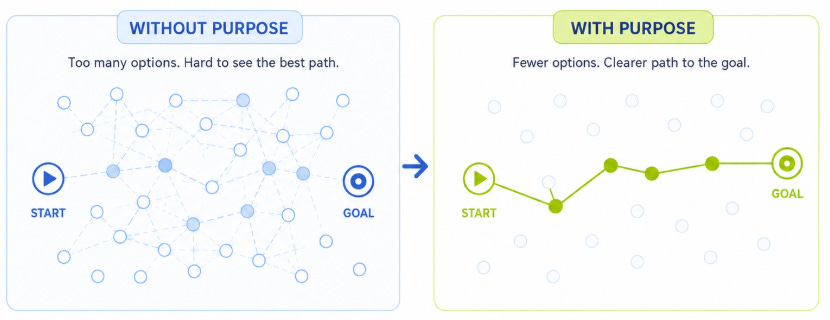
It tells you not only what to do, but also what not to turn into a problem.
This is one reason strategic intelligence often appears as restraint rather than expansion. A creative idea may produce dozens of possible implications. Good strategy identifies which implications matter to the present mission and contains the rest.
The cereal boxes did not need to become a scalable company. They just needed to work once.
Assess: find a path through the actual situation
Good assessment is not the same as collecting more information.
It means building a model that is detailed enough to guide the next decision.
The Airbnb founders could see several relevant features of their situation:
traditional investors were unconvinced
the company required money quickly
the presidential election had concentrated public attention
political memorabilia could influence more than the value of the cereal itself
design and storytelling were skills they already had
a limited production run would cap the cost and commitment
media attention could create value
This was not a complete model of Airbnb’s future. It was a minimum sufficient model of the immediate problem.
That phrase is important.
Under uncertainty, we are often tempted towards one of two errors.
The first is premature closure: acting on the first plausible idea without checking its assumptions.
The second is endless modelling: continuing to analyse because the whole future remains uncertain.
A minimum sufficient model sits between them. It contains enough structure to guide a useful, proportionate action while leaving room to learn.
The founders did not need to know whether Airbnb would become a global platform.
They needed to know whether they could create and sell a bounded product quickly enough to buy more time to learn.
Commit: choose a right-sized action
PACE treats commitment as a threshold problem:
When has thinking produced enough support for action?
The answer depends on:
the strength of the evidence
the cost of being wrong
the cost of waiting
the reversibility of the decision
the value of further information
For Airbnb, the immediate action was not to solve the entire accommodation business.
The actionable subgoal was narrower:
Create enough financial and strategic breathing room to keep pursuing the larger mission.
The cereal project met the commitment criteria reasonably well.
The evidence was sufficient for a limited move.
The founders knew that the election had created a temporary attention opportunity. They also had the design skills needed to produce a distinctive, saleable object. This did not prove that the cereal would succeed, but it provided enough support for a small experiment.
The cost of being wrong was contained.
Failure would consume some scarce time and money, but it would not require a factory, a permanent supply chain or a fundamental restructuring of Airbnb.
The cost of waiting was high.
The company was running short of money. Continued analysis could not preserve the business indefinitely. Without additional runway, the founders might lose the opportunity to keep testing their actual model.
The decision was reversible.
The election created a natural endpoint. If the boxes failed to sell, the founders could stop without turning the side project into a lasting commitment.
More information was unlikely to improve the decision as much as action would.
Market research could not reliably establish whether people would buy novelty cereal from an unknown start-up. Producing a limited batch would generate better evidence through real sales, publicity and audience response.
The cereal boxes were therefore a right-sized commitment:
Large enough to create breathing room and generate feedback.
Small enough not to consume or replace the main mission.
This is adaptive commitment — not maximum boldness or maximum certainty, but a timely, proportionate and revisable action whose scale matches the available evidence and the risks of both acting and waiting.
Evolve: what did the outcome change?
The cereal project produced several favourable results.
It generated cash and breathing space - a longer runway.
It attracted publicity.
And it helped communicate something important about the founders. During Airbnb’s Y Combinator interview, the accommodation idea itself reportedly met scepticism. But the cereal story caught Paul Graham’s attention. He saw evidence that these founders were unusually resourceful and difficult to kill.
That mattered because early investors are not evaluating only the current product. They are also making predictions about how a team will behave when the current model fails.
The boxes provided evidence of a more general capability:
These founders could create, ship, persuade and adapt under pressure.
In IQ Mindware terms, capability was potentially transferable. It might be useful again when the surface problem changed.
This is the beginning of what the broader framework calls the G-loop:
Predict, test, act, compare the result with expectation, revise the model — and retain only what continues to work.
The G-loop is the learning engine beneath PACE. It prevents action from becoming a sequence of disconnected improvisations.
A result should become one of three things:
a method worth retaining
a lesson that changes the model
or a better test to run next
The cereal project demonstrated that the founders could manufacture attention and revenue around a novel idea. It also improved their access to an alliance — Y Combinator — that could strengthen the next stage of the business.
But disciplined learning requires us to ask one more question.
What did the cereal boxes not prove?
Successful outcomes are seductive.
Once we know that Airbnb later became a major global company, every early action can look like evidence of an inevitable ascent. 📈
It was not!
The cereal boxes did not prove that strangers wanted to sleep in one another’s homes.
They did not demonstrate that hosts could be recruited reliably.
They did not solve trust, safety, payments, photography, market density or the economics of the platform.
They did not validate the core business model.
They proved something narrower:
the founders could design a compelling novelty product
some people would pay for it
the founders could generate cash under difficult conditions
the story could attract attention
the team was highly persistent and resourceful
These were valuable findings. They were not the same finding as product–market fit.
The distinction protects against false learning from success.
A favourable outcome may result from luck, timing, publicity or a capability that does not transfer to the main problem. Unless we identify exactly what an experiment tested, we may apply its lesson too broadly.
In this case, the cereal boxes validated the founders more than they validated Airbnb. They bought the company another cycle of learning.
And that was enough.
The cognitive state beneath the strategy
SPACE–PACE also distinguishes between the situation we are in and the way we are managing it.
The ‘zone’ we are in describes the cognitive landscape.
We may be:
Flat — running an established routine
In the Zone — open enough to adapt but constrained enough to decide
Spun Out — generating possibilities faster than we can organise them
Locked In — overcommitted to one model or goal
The PACE profile describes how we are handling evidence and commitment as we process information.
We may be:
Regulated — opening, narrowing and acting proportionately
Slow compensatory — continuing to analyse after action is sufficiently supported
Fast brittle — closing too early and acting before testing
Globally overloaded — unable to keep goals, evidence and decisions stable
These are temporary patterns that can change across situations and during the process of problem solving.
The early Airbnb team was operating under severe strain. Debt, rejection and uncertainty could easily have produced global overload: everything urgent, no stable path and reactive movement between ideas.
The cereal project helped impose a temporary boundary:
We need a limited action that produces cash and preserves the company.
That narrower purpose stabilised the problem and moved problem solving into a regulated state which helped them stay ‘in the zone’.
The founders opened themselves to an unconventional option, constrained it to a manageable form, committed to it and then used the outcome to create the next opportunity.
In everyday language, they recovered enough control to think and act coherently again.
Strategic intelligence is not the absence of crisis. It is the ability to restore a workable cycle inside one.
The transferable principle
The wrong lesson from Airbnb is:
When your business is struggling, launch a surprising side product.
The more useful lesson is:
When the main mission is threatened, look for a bounded side move that protects the base and preserves future options.
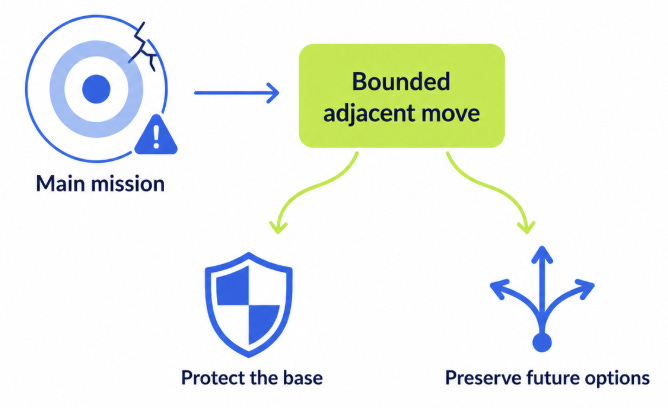
A good bridge opportunity has several features:
It addresses a genuine constraint.
It uses capabilities you already possess.
Its cost and duration are bounded.
It does not require you to abandon the main mission.
It can generate cash, evidence, attention, relationships or some other strategic asset.
You know what result would justify stopping, continuing or returning to the core work.
So before pursuing an adjacent opportunity, ask:
What is this opportunity for?
Which part of my wider system will it protect?
What will it prove — and what will it not prove?
Is it reversible?
When will I leave it behind?
Will it preserve my mission, or quietly replace it?
The best side move is not necessarily the one with the greatest independent potential. It is the one that improves your position while leaving you able to continue, revise or return.
This is a key ‘stratagem’ for strategic resilience: preserving enough money, attention, capability, trust and optionality to learn what to do next.
The cereal was not the strategy. Preserving the ability to continue was the strategy.
Coming this week: Attention Coach 🎯
Good strategy depends on more than having the right plan. You also need to keep the important signal in view, resist distraction and remain flexible when conditions change.
That is the capacity targeted by Attention Coach, the first module in the new IQ Mindware Cognitive Coach Suite. Attention sits at the foundation of the wider cognitive stack: before we can hold relationships in mind, anticipate what follows or reason well, we must first select what matters and maintain the task frame.
Attention Coach uses adaptive exercises and changing task formats to train attention control, rather than simply rewarding faster reactions or improvement on one familiar game. To test whether progress transfers beyond the trained task, it is re-checked under altered conditions rather than inferred from practice effects alone.
Train attention that remains stable when the task or context changes.
Attention Coach launches this week.