

The G-Loop: A Practical Tutorial
A practical tutorial for clearer thinking, better decisions and stronger follow-through

What it is
The G-loop is a simple way to move from complexity and confusion to useful action.
You can use it when you need to understand something, make a decision, evaluate an argument, plan a project, negotiate, learn from experience or recover your thinking under pressure.
The basic idea is:
Do not just think harder.
Run a better loop.
A good loop does five things:
Checks your current state.
Protects what must not be damaged.
Builds a clearer model of the situation.
Chooses the right-sized next action.
Learns from feedback and banks what worked.
The aim is not to produce perfect answers. The aim is to turn uncertainty into tested learning.
A Universal Loop of Intelligence
The G-loop formalises a recurring biological control architecture: protect viability, estimate organism–niche support, build a predictive model, act into the niche, evaluate prediction error, and stabilise what survives as future adaptive structure.
So the deep argument is that the G-loop is not just a cognitive productivity loop. It is a generalised life-loop: a controlled excursion away from a defended baseline state into adaptive search, followed by action, feedback, and stabilisation.
This fits Trident-G theory’s computational definition of intelligence as the capacity to maintain near-critical cognition across challenge, search relational problem spaces without collapsing into rigidity or fragmentation, validate useful structures across variation, and crystallise what survives into reusable crystallised intelligence The theory also explicitly treats the loop as a concurrent multi-layer dynamical system.
The 10 moves + state check
Think of this as 10 moves plus an entry gate. Move 0 is the state check: if you don’t have the bandwidth to run the loop properly, you shouldn’t be making strategic moves right now.
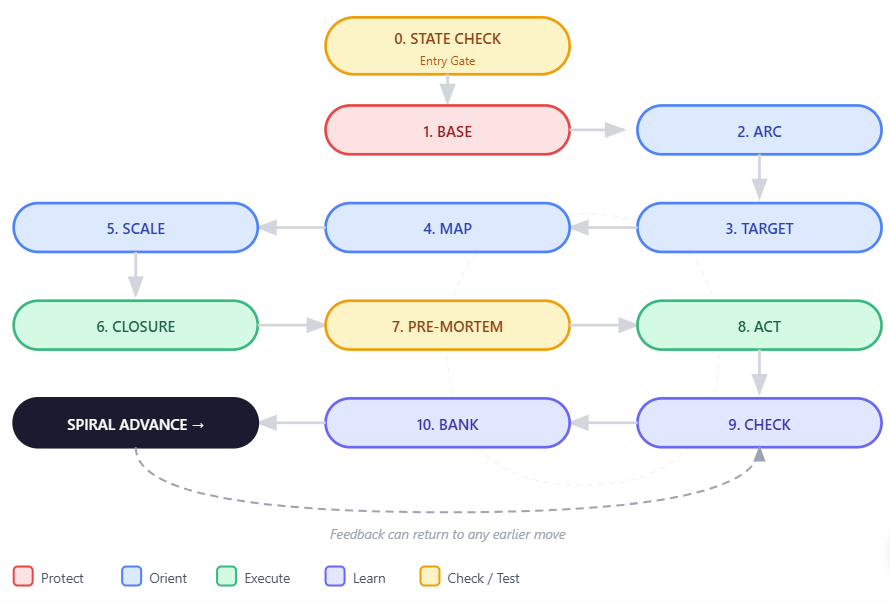
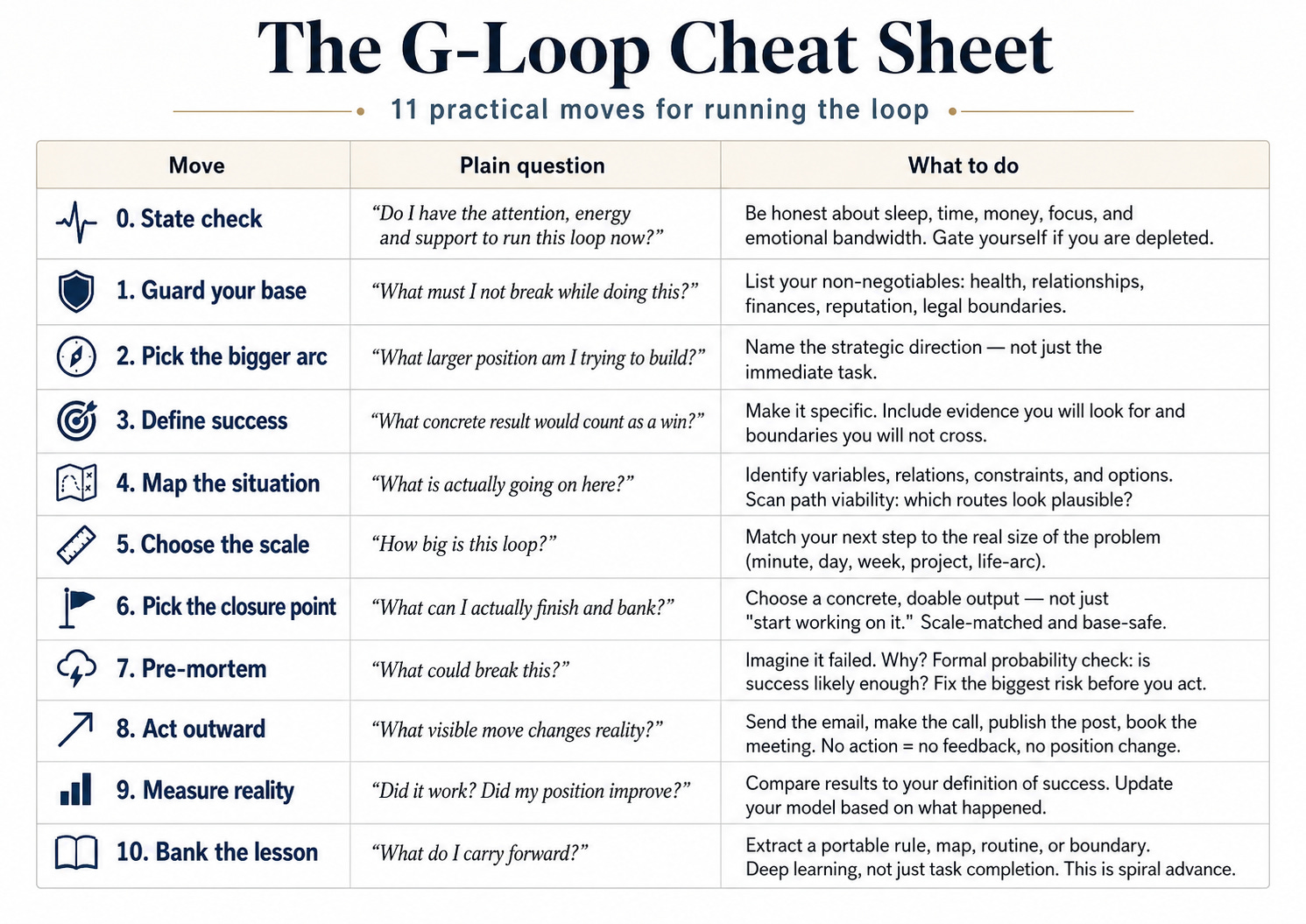
Important: The G-loop is written as a sequence, but it runs as a control system. In real use, action feedback can send you back to the target, the model, the scale, or even the state check. The written order is just a simple way to enter the loop.
Example 1: Decision-Making
Scenario: You’ve been offered a role at a startup. It’s exciting but risky. You’re not sure whether to take it, stay put, or negotiate.
Running the loop
0. State check
You have savings for 4 months, stable health, and a supportive partner. You’re sleep-deprived this week, so you decide not to decide today — you’ll run the loop over the next 3 days when you’re rested.
1. Guard your base
Non-negotiables: monthly rent + health insurance, one date night per week with partner, not burning bridges at current job.
2. Pick the bigger arc
You want to build career optionality — deep skills in a high-growth area plus a stronger professional network — not just a higher salary.
3. Define success
Target state: Accept, reject, or negotiate a specific counter-offer by Friday.
Strategic reason: Either gain a high-growth skill platform or secure a better role at your current company.
Evidence: Signed offer or signed counter-offer, or clear “no” with relationships intact.
Boundary: No decision that puts you under 3 months of savings.
4. Map the situation
Variables: salary, equity, role scope, manager quality, commute, learning curve, company runway.
Options: Accept, reject, negotiate (salary, title, remote days), or defer.
Constraints: You need health insurance continuity; the startup’s funding round closes in 6 weeks.
5. Choose the scale
This is a project-level loop (days to a week). You don’t need a 5-year plan today; you need a clear decision by Friday.
6. Pick the closure point
“By Friday 5pm, I will have either (a) a signed offer with my negotiated terms, (b) a signed retention agreement at my current job, or (c) a polite, relationship-preserving decline with the startup.”
7. Pre-mortem
What could break this?
You romanticise the startup and ignore red flags in the runway.
You negotiate too aggressively and they withdraw the offer.
You say yes out of fear of missing out, then panic.
Fix: Ask the startup for a 15-minute call with the CFO about runway. Run the numbers on equity independently. Sleep on the final decision.
8. Act outward
Send the CFO call request.
Draft a respectful negotiation email with 2 specific asks (salary floor + 2 remote days).
Schedule a conversation with your current manager about growth paths.
9. Measure reality
CFO call reveals 8 months of runway, not 18. You update your risk model.
Current manager offers a new project lead role in 3 months.
You now have options, not just an offer.
10. Bank the lesson
Banked rule: “Always verify runway independently before weighing startup equity.”
Banked routine: “For any job decision, run the 4-month savings floor check and verify runway.”
Example 2: Strategic Action Meta-Function
Scenario: You want to build a writing habit that actually advances your career, not just produces noise.
Running the loop
0. State check
You have 6 hours/week of focused time, a stable day job, and no existing audience. You’re not burned out, so you have capacity for a 90-day loop.
1. Guard your base
Do not: sacrifice sleep, use work hours, or spend money on expensive tools before proving the habit.
2. Pick the bigger arc
Build authority in one niche and create a reusable portfolio of writing that opens doors (talks, consulting, job options).
3. Define success
Target state: 6 published pieces in 90 days on a single topic, with one piece getting shared by someone you respect.
Boundary: No more than 6 hours/week. If it’s not working by week 6, pause and reassess.
4. Map the situation
Variables: topic focus, platform, writing quality, distribution, consistency.
Constraints: Limited time, no audience yet, perfectionism is your historical failure mode.
Key insight: Distribution matters more than perfection when you have zero audience.
5. Choose the scale
This is a project-level loop (90 days). Inside it, you’ll run smaller weekly loops (draft one piece) and session loops (write for 90 minutes).
6. Pick the closure point
Not “start a blog.” Not “write 50 articles.”
The right closure: One published piece per week for 12 weeks, with a 2-week buffer built in.
7. Pre-mortem
What could break this?
You spend 3 weeks perfecting one piece and quit.
You write about too many topics and no one knows what you stand for.
You publish into the void, get zero feedback, and demoralise yourself.
Fix: Cap drafting at 3 hours per piece. Pick one topic. For the first 4 pieces, send each directly to 3 specific people who work in that niche and ask one concrete question.
8. Act outward
Publish piece #1 on LinkedIn/Substack.
Send it to 3 niche peers with the message: “I wrote this about X. I’d love to know if the framing in paragraph 3 matches what you’ve seen.”
Book a recurring 90-minute block on Sunday mornings.
9. Measure reality
Week 3: One peer shared it. That’s your first signal.
Week 6: You have 3 pieces but topic drift is starting. You tighten back to the original focus.
Week 10: A reader asked you to consult. Your position changed, not just your activity.
10. Bank the lesson
Banked rule: “Cap polish time at 3 hours. Distribution beats perfection at zero audience.”
Banked routine: “Every piece gets sent to 3 specific people with one concrete question.”
Banked asset: A 6-article portfolio you can point to in any future conversation.
Quick Cheat Sheet
Use this to run any loop in under 10 minutes.
0. STATE: Do I have the attention, energy and support to run this loop now?
1. BASE: What must I not break?
2. ARC: What bigger position am I building?
3. TARGET: What does success look like, specifically?
4. MAP: What are the real variables, relations and options?
5. SCALE: Is this a minute, day, week, project or life-arc problem?
6. CLOSURE: What will I actually finish, test or bank?
7. PRE-MORTEM: What is the most likely way this fails?
8. ACT: What actions you take?
9. CHECK: Did reality match my model? Did my position improve?
10. BANK: What rule, map, asset or routine do I keep for next time?
The G-loop is written as a sequence, but it runs as a control system: feedback can update any earlier part of the loop.